I am pleased as punch with how many events are shaping up for green woodworkers this summer. If you have not heard, the folks at Plymouth CRAFT are putting on a "Greenwood Fest" the weeknd of June 10th. They have secured the venue: the lovely Pinewood's Camp. They are also in the process of securing instructors. David Fisher has already committed to being one, which in and of itself is a reason to go. But if that was not enough, I have gotten a lot of teasing emails from Peter and Dave about who else might be coming. I have been sworn to secrecy, but suffice to say, when this registration opens, you need to sign up. Don't miss this if at all possible. Follow CRAFT's newsletter or Facebook page to stay on top of things.
Also, on a much, much smaller scale, in early August I am hosting a small gathering of Northeastern carvers. The folks coming are largely those that I have met through the wonderful gatherings at Oliver's. I am just trying to share the love with a great bunch of people. We will carve spoons, turn some bowls on my lathe, and generally enjoy summer in New Hampshire. That weekend is also the New Hampshire Craftsmen's Fair, so we might take a trip over to Sunapee and take in that scene. Should be a blast.
I am sure all of us have had the experience of starting a much anticipated adventure, only to find that you have forgotten something crucial to getting the most out of that experience. Like going to the Grand Canyon and forgetting to bring your camera? Well, my most recent experience with this was arriving at Lie Nielsen for a class with Jogge Sundquist and realizing that I had forgotten to bring a sketchbook. Thankfully my friend Dave gave me a few pages torn from his and I muddled by, but it was not the same. I really missed having a sketchbook.
And what made this really annoying is that I had a lot of sketchbooks at home, in all shapes and sizes. I just can't seem to find one that really meets my needs, so I just keep buying more. Sometimes the pages won't lie flat and I end up breaking the spine. Sometimes the tooth of the paper is too fine and won't easily accept both pen and ink. Most times the book disintegrates in my bag, the pages separating from the cardboard cover. And where to put your pencil, ruler, eraser, etc...? Shouldn't sketchbooks accommodate accessories?
So, I finally decided to make my own.
I chose to make a wrap-around cover out of full grain leather, secured with just a simple strap. This offers great protection to the pages while the book bangs around in my bag.
Since I made it myself I could mix and match what paper went into the signatures, so I would never want for a particular type. Drawing paper? Check. Watercolor paper? Got that. I even added vellum and brown packing paper just for kicks. Because the signatures are stitched directly to the leather cover, the pages lie pretty flat, and if they don't I can mash them down with glee, knowing there is no spine to break.
I also added a pocket on the back inside of the cover for pencils, rulers and my drawing compass.
The compass been my new favorite tool in laying out new spoon designs (though I am enjoying using Don's SDK template.) A while back I posted my thoughts on the book By Hand and Eye by Walker and Tolpin. They describe how pre-industrial design was done largely by proportions as opposed to measurements, and this got me thinking about what basic measurements go into spoon design. I have decided that bowl width is the "unit" of my spoons, so that all other elements are proportions of that. The results of this sort of thinking look like this:
I lay out a key on the side, stepping out fractions of the diameter of the spoon bowl. Once done, they become my "palate" for spoon design. I still sketch the basic form, but the various circles help keep things symmetrical and in proportion. Once done I trace onto plastic and make a template.
On a related note, Dave Fisher just posted a great bit on the importance of "Reference Sketching."
One more thing: the journal project was a great one to do with my daughters, who both wanted their own when they saw mine. It is a relatively easy and safe project to do with kids. While I had to cut out the leather and punch the holes in the leather for the signatures, the girls dyed the leather, punched the holes in the signatures and stitched the signatures in. Saddle needles are not sharp, so not much risk there. Now they are the envy of all of their friends. Hannah chose brown, and Mazie chose the oxblood with added concho for bling.
This past weekend I went back to Oliver's place for another spoon gathering. It still amazes me that Oliver is so generous with his time and space. To invite a bunch of spoon nerds he met on the internet into his home is really extraordinary, especially given that we all come with lots of knives and axes. Thanks to Oliver and his family for hosting.
I wish I had taken more photos of his place. His barn is so cool that they rent it out for weddings. An amazing space. We made a mess of it.
Photo by Paula Jacobson
Of course, the people there were really why I came. A chance to meet Alex Yerks, Don Nalezyty, Derek Sanderson, Pat Alan Diette, and Paula Jacobson was not to be missed. I have been amazed by their work for a while so it was great to meet them and talk spoons. I met some great new people, like Annie "Almond" Swift and Chuck Trella, and caught up with acquaintances from Oliver's last gathering. Strangely, I took no photos of the people, save this one of Pat and Alex camping out.
The amount of craft on display was simply amazing. We all brought examples of our own work and bits from our collections. It was truly overwhelming. That many examples of excellent design and execution sort of unrooted me. So many directions to take, I don't quite know where to go now.
Photo by Paula Jacobson
Dan Music, photo by Jeff Kuchak
Craft was what I shot the most. So many inspiring examples.
Jarrod Stone Dahl
Jan Harm ter Brugge
But again, meeting and carving with all of these great people was definitely the highlight of the trip.
next three photos by Paula Jacobson
Oliver and I in heated discussion about boxes. Looks like I am about to attack him with his own scorp.
Talking power strokes with Theresa and Stéphanie.
(Not sure what Alex and Luc are discussing. Maybe big spoons? Must be the Pabst.)
Anyway, it was a fantastic weekend, full of excellent food (Don's pizza dinner and porridge breakfast were highlights for me) and great conversation. Oliver, Paula and I discussed spoon design for quiet a while, which sort of got me back on track. Next time, I will spend less time carving and more time watching, learning and shooting photos.
Every fall for the past sixteen years I have gone to Plimoth Plantation with my U.S. History students. It is a "working" day for me, but an easy one by all measure.
like a day at the beach...
For those unfamiliar with Plimoth Plantation, it is a "living history museum," with role players interpreting both English and Wampanoag perspectives. You want to chat with Miles Standish or William Bradford, have at it.
With this much historical expertise, I pretty much leave the teaching to the staff and spend my time wandering around. Over the years I found myself drawn more and more to the Craft Center, and especially Peter Follansbee's workshop. As I have said elsewhere, Peter was a big reason why I got interested in green woodworking.
But Peter moved on to greener pastures (as have many of the Plimoth craft people), and so the place feels, well, a little empty. The Craft Center has been renovated, but there does not seem to be much craft going on there. It is pretty much a bakery and a gift shop now. I did see one potter throwing period pieces on an electric wheel, and period food ways are certainly interesting and worthy of study, but it just does not feel the same. For a living history museum, its presentation of craft was pretty dead. I am sure they will get back on their feet, but it definitely felt like a transitional time for the museum.
And so this last visit I wandered through the Mayflower II and the 1627 English village, poking around and looking for signs of Peter's work. It was everywhere, like ghosts hiding in dimly lit corners.
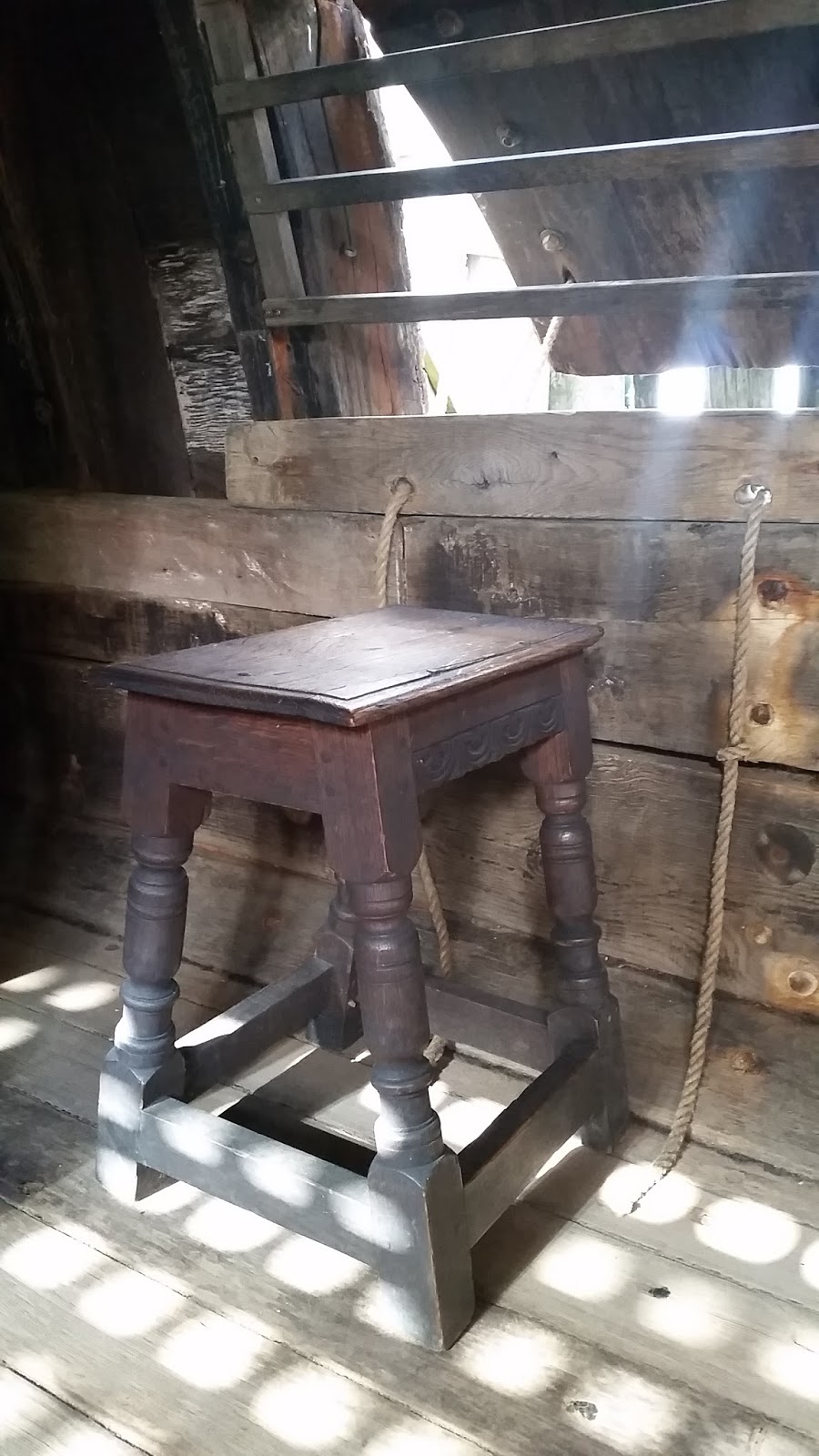
This shot felt especially sad. Peter's work, behind glass and with museum labels...
Spoon by Dave Fisher, out of witch hazel (who knew you could carve witch hazel!!!)
This spoon is so nice it deserves a post in itself. Not a speck of wood to spare, and the lettering is gorgeous.
Spoon by Ben Kirk
Love that robust keel
Japanese lacquered spoon, by Masashi Kutsuwa. His wife did the lacquering. Seven or so thin coats. You can also make out the rough cloth under the lacquer on the handle. I loved how its texture broke up the uniformity of the spoon.
The surface is not just shiny, it pulls you in...
Ainu spoon, from the collection of Masashi Kutsuwa
One of the wonderful parts of the recent course with Jogge was that he brought a bunch of his little boxes. We got shots of a few, but many more went unphotographed, especially the ones for his tools. They are charming, colorful and inventive. His use of color is really interesting (especially on some unphotographed tool cases, were he used complex, muddy greens, something my art friends call "broken greens.") Jogge's boxes really got me thinking--in fact, they have literally gotten me up in the middle of the night. So, here are some pics of his boxes, and one that I made quickly to protect my new Nic Westermann twica cam.
First, a sweet little box with a swivel top and a small accompanying salt spoon
Photo by Alex Jezerski
Next, a box for name cards in the shape of a book.
Photo by Alex Jezerski
Photo by Geoff Chapman
...and a detail of the wedge that keeps the lid from sliding out. Finally, an amazing box for pencils and the like. Love the coffin shape and the little Surolle face on the top. The inscription taunts you. It says something like "Only my heart is open", but opening it is a real trick...
Photo by Alex Jezerski
You can just make out the wedge on the end, which must come out first. Once out, you can then remove another wedge on the bottom. This allows a pin to drop out of a hidden hole in the bottom that was locking the lid in place. Very clever. Fooled me first time around. One design note: Jogge's lids are wedge shaped. This means there is relatively little friction as they start to slide into place, and can be snugged up into the final position. Finally, here is my first take on a box for my new hook knife. I used older birch, which was a mistake as it had a little punky streak running through it. That part cracked on drying. I will use it until it breaks and glue it back together. Carving and paint to come...
A few weeks ago I had the great fortune to take a class with Swedish woodcarver Jogge Sundqvist at Lie Nielsen Toolworks in Warren, Maine. For those who don't know about Jogge, he and his father Wille have had a tremendous influence on green woodworking in America, going well back through the 70s, when they started teaching classes in Swedish carving at Drew Langsner's Country Workshops. Of course, Drew later got Peter Follansbee started in the field, who then went on to research and popularize seventeenth century joinery and carving techniques. Peter also studied with the Sundqvists, and carves wonderful spoons himself. Given the influence these three men have had over green woodworking in America, I felt truly blessed to have all three present in Maine. Drew and his wife Louise joined us for the second day. The chance to ask questions and get to know these great craftsmen was a real eye opener, and has left my head spinning with ideas.
Another excellent part of this weekend is that I got to reconnect with Dave Fisher, an amazing bowl carver who I got to know a few years ago when he agreed to teach me some of his methods. Since then we have stayed in contact, corresponding about woodworking and teaching (we both teach high school history.) We signed up for the class together, and agreed that I would pick him up from Logan airport and we would drive north and camp out behind Lie Nielsen (when I asked the folks at Lie Nielsen if camping was OK, they said "not only is that OK, it is kinda awesome.") What was also cool was that others would be camping out with us. Ben Kirk, a great spoon carver from Maryland who I got to know last summer at Peter Follansbee's spooncarving course, was camping out at Lie Nielsen as well. He also brought his lovely wife Chrissy (who puts up with an amazing amount of spoon talk with a smile) and his friend (and bandmate) Ryan. We had a great time kicking back in the evenings over beer and spoon talk.
I learned a lot during the class and in long conversations with Dave and Ben--too much to run through here. With Jogge we carved spreaders and distaffs (for wooing women) and talked technique. Jogge taught the basic grasps and helped me with my "can opener" and "cross thumb" motions. I also learned a lot from Dave and Jogge about engraving, including advantages to different tool profiles, engraving grasps, and how to carve "uphill" and still get smooth results. Again, too much to describe in one post.
Dave and I laughed at what slow progress we were making on our projects, too busy talking with great people to make much headway. And those people were really what inspired me the most, beyond all the technique talk. I got to talk with Masashi Kutsuwa, a Japanese woodworking professor who had flown in for this class and a pilgrimage to Dickinson Reach. We spoke of Japanese craft and how green woodworking had started taking hold in the US. I got to chat with Peter Lamb about his friend Bill Coperthwaite's wonderful experiment in living. I never got to talk as much as I would have liked with Kenneth, a boat builder from Maine who was helping teach the class, or many of my classmates, most of whom seem to have been crafting in their various fields for more years than I have. Such a wealth of knowledge... That is what makes these courses truly great. The people.
Photo by Colin Hayward
Jogge finished his class with a summary of the "four walls" of craft that bound and shape our work: material, tools, people and tradition. I certainly felt the importance of "people" on my craft this weekend. A few days later, one of my classmates, William MacIntrye, posted a great question on our email list following the workshop: "I have been able to identify with all but one; the wall of tradition. Since we, as modern woodworking Americans, may not have knowledge to create objects such as the wooden spoon, knife, bowl, or distaff handed down from generation... How do we define our tradition? What object do we connect with if we haven't been around it our entire lives?" His question really made me consider how important people like Jogge, Drew and Peter are for us, because in many ways, they are our tradition...